How will agriculture and forestry climate policies impact sustainable development?
- {{"article.by"|translate}} Ema Gusheva
- {{"article.posted"|translate}} 10-12-2021
How will agriculture and forestry climate policies impact sustainable development?
In October 2021, we consulted national experts through questionnaires in order to continue our study of the links between climate change mitigation policies and the Sustainable Development Goals (SDGs) for the agriculture and forestry sectors.
The national experts quantified the national relevancy of 63 links form scientific literature and justified their opinion with specific examples and comment. In other words, they looked at the 10 policies and measures (PAMs) from the enhanced Nationally Determined Contribution to the Paris Agreement (2021) and the SDG targets. Specifically, there were 26 positive links (synergies) with the SDGs for agriculture, and 37 links with the SDGs for forestry out of which 5 were negative (trade-offs) found in scientific literature. The approach used, called Q-SCAN, is a method for engaging stakeholders and systematic quantification of the national relevance and importance of the NDC-SDG links.
Figure 1 portrays the results for the forestry sector. As mentioned before, there were 32 synergies and 5 trade-offs identified in scientific literature, so it is not surprising that our results show significantly more synergies (annotated with green) than trade-offs (annotated with orange). The rough conclusion from this is that NDC PAMs will have a larger positive than negative impact on SDG progress. However, it is important to note that the national experts evaluated almost all links to be of medium or low importance. One exception to this is the synergy with SDG 6: Clean water and sanitation through conservation, restoration, and sustainable management of natural areas, which was evaluated as a link of high national relevance and importance. Still, they warned that good results for this goal can only come from the right choice of allochthone species and that the existing PAMs need to be expanded to include all important drinking water sources in the country and that special forest management plans need to be in place for the areas that surrounds them.
Next, the largest number of synergies were with SDG 15: Life on land as the experts assessed that the adopted PAMs contribute to biodiversity conservation through, for example, protection from erosion or sustainable wood cutting, which in turn protects the habitats of many species. Additionally, there were comments that biodiversity can also increase after forest fires and that more needs to be done to protect against erosion, for example, through the application of a combination of measures with an ECo_DRR and NbS approach. On the other hand, the most significant trade-offs, evaluated with medium national relevance and importance, are with SDG 2: Zero Hunger and SDG 10: Reduced inequalities. Particularly, national experts highlight that, even though the PAMs address forest conservation, there are legal barriers preventing access to certain resources which makes hunger reduction more difficult and lead people to quit forestry which increases socioeconomic inequality.
There was some dissensus among national experts regarding the link with SDG 8: Decent work and economic growth. While some state that the PAMs will not create many new jobs and that the resulting economic development is insignificant, others state that the establishment of new protected forest areas is a specific measure which will create many new jobs. Vodno mountain is taken as an example since more than 1000ha of clear-cut land has been reforested there since 1924, enabling it to become an important recreation area capable of generating commercial benefits to its users. The same example is used for justifying the links with SDG 11: Sustainable cities and communities. In the past there were many devastating floods in the Skopje region and material damages and casualties were common, but reforrested Vodno acts as a natural barrier. In fact, model simulation about the outcomes if Vodno had not been reforested are very negative. This is a great argument for expanding reforestation throughout the entire country.
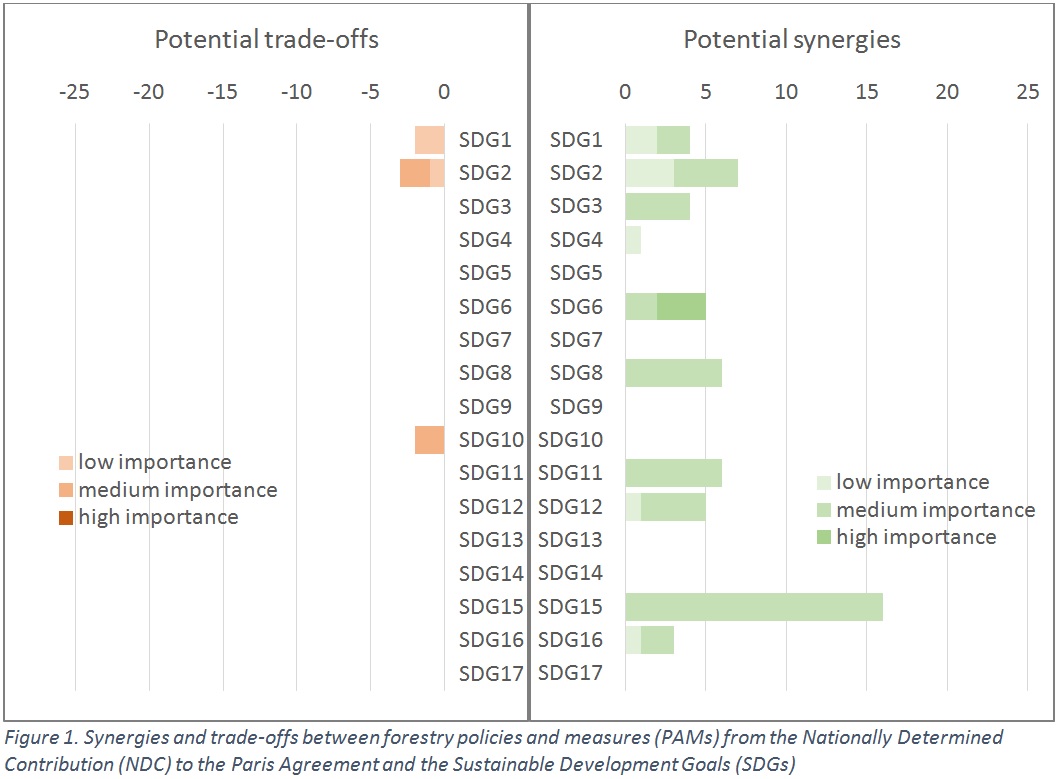
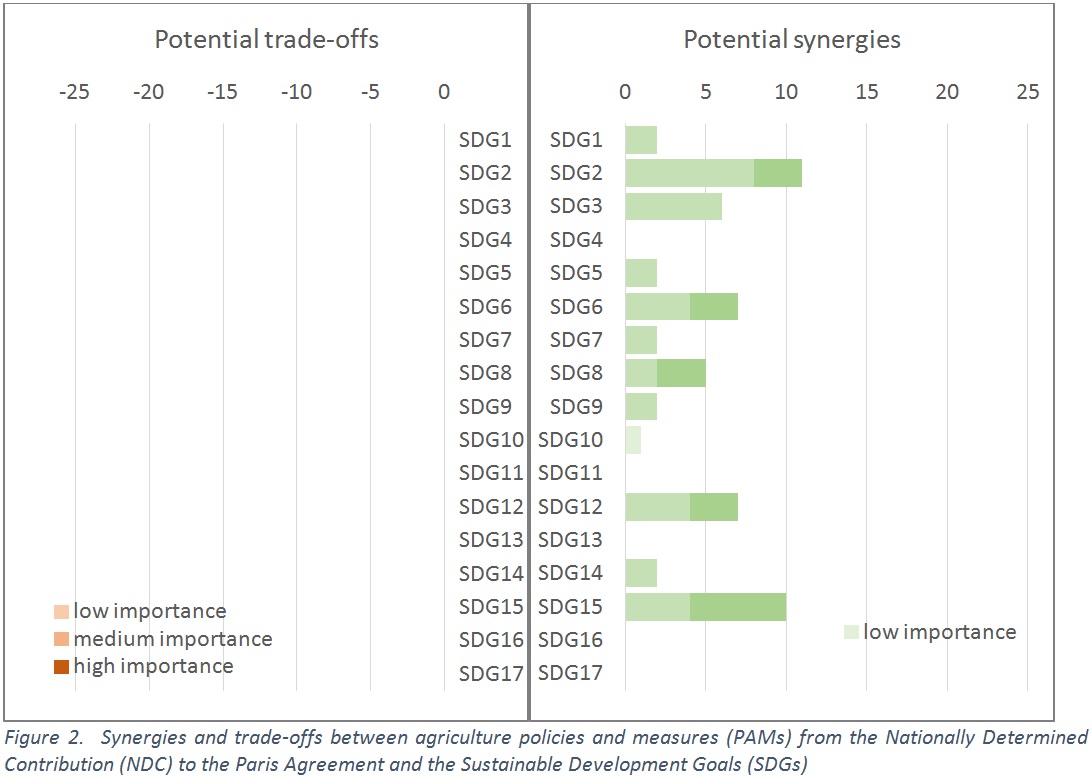
Figure 2 presents the results from the agriculture sector. There were only positive links, i.e. synergies, between agriculture climate mitigation actions and the SDGs identified in scientific literature. Thus, the results show that NDC PAMs in the agriculture sector will only have a positive impact on the SDGs. Just like the forestry sector, the most significant synergies are with SDG 15: Life on land mostly due to improved irrigation and less soil degradation. The national experts assessed that this would contribute towards ecosystem conservation through more efficient water use during irrigation and protection against land erosion.
Next, the national expert evaluated that the PAMs will also positively impact the economy, i.e. SDG 8: Decent work and economic growth, because they will increase production efficiency through improved irrigation and fertilizer use. The link to SDG 6: Clean water and sanitation is also significant because the measures predict less water use through efficient irrigation systems. Likewise, the link to SDG 2: Zero hunger was deemed important since the PAMs would lower crop loss through good agricultural techniques during harvest season. Likewise, there was a comment regarding this SDG, which states that it is imperative to base all agricultural techniques are based on scientific analyses regarding soil use and crop suitability, to apply the techniques in an adequate and timely manner so as to optimize cost and crop productivity, thus maximizing income.
Further, the link to SDG 12: Responsible consumption and production is significant because food waste is an important national problem. In fact, it is common to see images of huge amounts of apples or onions being thrown away by the farmers in the media, so the PAMs have a huge potential to increase the sustainability of production practices. Last, many of the mitigation actions identified in scientific literature are not nationally relevant because they concern agroforestry, which is not covered by the NDC PAMs.

-
Корисни линкови
26-01-2021 -
Справување со климатските промени и загадувањето на воздухот во градот Скопје
29-04-2018 -
Финансирање во климата
28-01-2022 -
Микронаративи
08-06-2022
{{"article.lastestPosts"|translate}}
-
Презентирани сценаријата и мерките за ублажување на климатските промени: одржани национални работилници за финалниот нацрт на БТР1 и NDC 3.0
06-01-2026 -
Клучен исчекор кон поголема климатска транспарентност: одржана национална работилница со широк мултисекторски ангажман
10-12-2025 -
Обраќање на Генералниот Секретар на Обединетите Нации, Н.Е. Антонио Гутереш за нужноста од климатска акција, 10 години после Парискиот договор
10-11-2025 -
Стопанската комора на Северна Македонија го изработи првиот водич за декарбонизација за малите бизниси во земјата
28-10-2025


 Мод за знаковен јазик
 Говорен асистент
 Означи линкови

 Зголеми маус