Macedonian #ClimateChange challenges and perspectives
On the road below 2 degrees: Where does the world stand?- {{"article.by"|translate}} Natasa Markovska, RCESD-MASA
- {{"article.posted"|translate}} 20-03-2018
Macedonian #ClimateChange challenges and perspectives
On the road below 2 degrees: Where does the world stand?
The Paris Agreement represents a dramatic departure from the past 20 years of climate negotiations, providing a broad foundation for meaningful progress on climate change. It is underpinned by the intended nationally determined contributions (INDCs) that reflect the national climate policies and actions of the countries. Once countries formally join the Paris Agreement, their “INDCs” shall be considered “NDCs”.
The Paris Agreement represents a dramatic departure from the past 20 years of climate negotiations, providing a broad foundation for meaningful progress on climate change. It is underpinned by the intended nationally determined contributions (INDCs) that reflect the national climate policies and actions of the countries. Once countries formally join the Paris Agreement, their “INDCs” shall be considered “NDCs”.
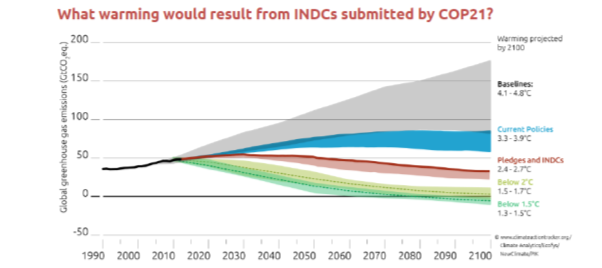
Figure 1. Emissions pathways and projected temperatures in 2100 under current policy and pledge scenarios (source: Climate Action Tracker)
All countries that have ratified the Paris Agreement are asked to ‘formulate and communicate long-term low greenhouse gas emission development strategies.’ Developed countries (Annex I countries) that already have 2050 targets can review their plans in the context of the agreed goals, as most of these plans must be strengthened, and developing countries (Non-Annex I Countries), like the Republic of Macedonia, can build on the experience of the INDC process to work from existing plans and develop longer-term visions.
Macedonian dual status, requirements and synergies
Macedonia has actively contributed to the climate change international processes by fulfilling its reporting requirements. These requirements are different - under the United Nations Framework Convention on Climate Change (UNFCCC) Macedonia has status of Non-Annex I country, while as a candidate country for EU membership, must adhere to EU Climate and Energy Policy, which actually assumes the commitments of Annex I countries (Figure 2). With regards to EU aspect, the Ministerial Council of Energy Community (EnC) adopted a recommendation on the monitoring of greenhouse gas emissions and under the Western Balkan (WB) Sustainable Charter, the six countries (WB6) are requested to explore the best way for improving their systems for monitoring, reporting and planning their energy and climate policies and aligning them with EU relevant policies.
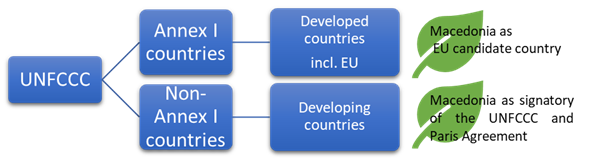
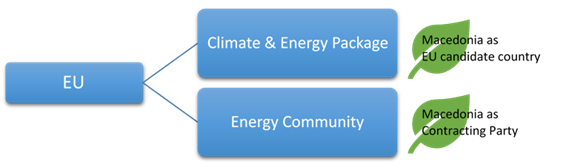
Figure 2. Macedonian climate change reporting requirements
The reporting to UNFCCC is conducted through National Communications (NCs), Biennial Update Reports (BURs), and National Inventory Report, which have pre-defined content and level of detail (Figure 3). The reporting towards EU (Annex I Party) is similar, but the required content and the timetable for its submission are more demanding.
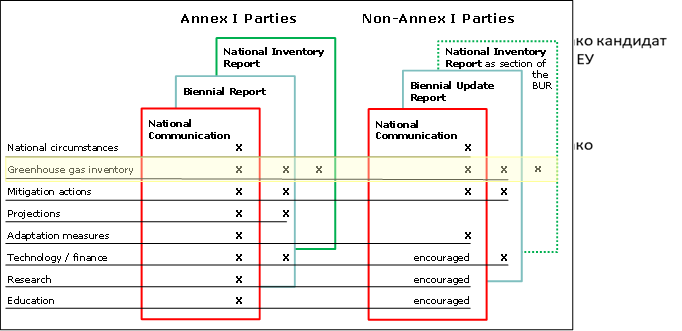
Figure 3. Reporting to UNFCCC
By combining available support (both financial and technical) from both UNFCCC and EU, the country has been able to voluntarily incorporate the Annex I UNFCCC reporting principles, required as a EU candidate country, as much as possible within the framework of the NCs and BURs.
The Table 1 summarizes the UN reporting requirements for GHG inventory and NCs, BURs, and Mitigation Action and highlights how the specific issues are implemented in Macedonian conditions. The level of implementation in Macedonia is evaluated as: Annex I like, Tends to Annex I like, Steps towards Annex I like, or Non Annex I.
Table 1: Summary of UN reporting requirements
| Annex I Party | Non Annex I Party | Macedonia |
|
GHG Inventory Requirements | ||||
Frequency | Submit annual inventories to the UNFCCC in an electronic format. | No set frequency; can be submitted in hard copy. Upon availability of resources | GHG inventory submitted in electronic format as part of the National Communication or Biennial Update Reports. Annex I like
|
|
Coverage | Trends in emissions of the six primary GHGs1, from 1990 to the most recent year for which data is available; includes sectoral background data. Kyoto inventory systems have additional structural detail. | Trends in emissions for CO2, CH4, and N2O only, with estimates for other gases encouraged but not required from 1990 or 1994 for the first inventory and 2000 or later for the second; sectoral background data is not required. | Trends in emissions of the six primary GHGs are reported for 1990-2012, including the sectoral background data. Annex I like
|
|
Standards | Use both the IPCC Guidelines and Good Practice Guidance and thoroughly document emissions estimation methods and data sources. | Use IPCC Guidelines; use of the Good Practice Guidance encouraged but not required. Documentation of methodologies is encouraged. | The 2006 IPCC Guidelines and Good Practice Guidance used for reporting; Emissions estimation methods and data sources are thoroughly documented. Annex I like |
|
Methods | Generally adopt higher-tier methods | Generally adopt lower-tier methods | Higher-tier methods are generally adopted. Annex I like |
|
Review | Subject to annual review by expert teams following agreed upon review guidelines. At least once every five years, inventory systems are subject to a more detailed in-country review. Parties to the Kyoto Protocol are subject to more rigorous review, and if review teams determine a Party’s inventory report or system is deficient, the Party may be judged to be out of compliance and subject penalties | No subject to review | Voluntary review by experts under the National Communication Supporting Programme (NCSP) conducted.
Tends to Annex I like
|
|
NCs, BURs, and Mitigation Action Requirements | ||||
NC Frequency | Submitted every five years | No specified frequency | Voluntary, submitted every five years Tends to Annex I like |
|
NC Content | National Communications include a description of each mitigation policy and measure, organized by sector and gas. Description includes status, implementing body, and, if possible, estimated effect on emissions to date and in the future. | Encouraged but not required to report on mitigation policies and measures. | National Communications include a description of each mitigation policy and measure, organized by sector and gas. Tends to Annex I like |
|
BUR Frequency | First one on 1 January 2014, then every two years | First one in December 2014, then every two years | First one in December 2014, than every two years Annex I like |
|
BUR Content | Outline progress in achieving emission reductions and the provision of financial, technology and capacity-building support to non-Annex I Parties. | GHG inventory not more than four years old Information on mitigation actions | GHG Inventory from 1990-2012 Information on mitigation actions
Steps towards Annex I like |
|
Actions | Subject to binding national emissions targets, and international monitoring and reporting requirements to verify the achievement of these targets | None | Voluntary international monitoring and reporting requirements
Steps towards Annex I like |
|
Review of NC | National Communications are also subject to international expert review, conducted in accordance with internationally-agreed guidelines | Not subject to review | Not subject to review
Non Annex I |
|
Review of BUR | Subject to international expert review, conducted in accordance with internationally-agreed guidelines. | Process of international consultation and analysis (ICA) | Process of international consultation and analysis (ICA)
Non Annex I |
|
Raising ambition
To shorten the Macedonian case story- the GHG Inventory reporting to a great extent is “Annex I like” or “Tends to Annex I like”. It meets the necessary technical conditions for ensuring sustainability, since a strong focus is put on documenting essential information in a concise format, the activities and tasks are standardized and clear procedures stipulated, as well as the roles and responsibilities of all players are clearly defined. It is also publicly accessible, as the inventory database, documents and infographics are published at: http://www.unfccc.org.mk/Default.aspx?LCID=229
Furthermore, many of Annex I UNFCCC reporting principles are incorporated in the Macedonian NCs and BURs. Namely, starting with the First BUR, the mitigation analyses are conceptualized through WOM (without measures), WEM (with measures) and WAM (with additional measures) scenarios. Also, as a part of the First BUR, a conceptual Monitoring, Reporting and Verification (MRV) framework was developed including an appropriate institutional setting.
This significant progress in reporting has been recognized by the UNFCCC and several processes and tools were identified as good practices worldwide. In addition, all these achievements have contributed to capacity building in the country, both, the analytical and the capacities of policy makers and all stakeholders to respond to more demanding reporting requirements.
On the mitigation side, within the scope of the Macedonian latest Climate Change Report (2018), it is demonstrated that raising Macedonian climate change ambition is possible by implementation of 46 measures (35 measures in the Energy sector, 8 measures in Agriculture, Forestry and Other Land Use (AFOLU) and 3 measures in the Waste sector) selected from national strategic and planning documents. Moreover, approximately 80% of all emission reductions can be achieved through the implementation of ‘win-win’ measures, i.e. implementation of these measures will not only reduce emissions but ALSO create financial savings.
Summing up, the Republic of Macedonia might be small in size, but big in understanding that everybody has a role to play in combating climate change.

-
Корисни линкови
26-01-2021 -
Справување со климатските промени и загадувањето на воздухот во градот Скопје
29-04-2018 -
Финансирање во климата
28-01-2022 -
Микронаративи
08-06-2022
{{"article.lastestPosts"|translate}}
-
Презентирани сценаријата и мерките за ублажување на климатските промени: одржани национални работилници за финалниот нацрт на БТР1 и NDC 3.0
06-01-2026 -
Клучен исчекор кон поголема климатска транспарентност: одржана национална работилница со широк мултисекторски ангажман
10-12-2025 -
Обраќање на Генералниот Секретар на Обединетите Нации, Н.Е. Антонио Гутереш за нужноста од климатска акција, 10 години после Парискиот договор
10-11-2025 -
Стопанската комора на Северна Македонија го изработи првиот водич за декарбонизација за малите бизниси во земјата
28-10-2025


 Мод за знаковен јазик
 Говорен асистент
 Означи линкови

 Зголеми маус